
Little River County Court Records
After a Little River County arrest, two record tracks can exist at the same time. The first track is the jail or booking record held by the Little River County Sheriff's Office. It may show arrest time, confinement time, release time, reason for confinement, offense level, arresting officer, and warrant or commitment data. The second track is the court case. That record begins when a prosecutor, officer, or court filing starts a criminal case and the matter is indexed by the court.
The distinction matters because booking charges are not always the charges that appear in court. Sheriff staff may assemble reports and evidence for the prosecuting attorney, then the prosecutor decides what to file, amend, reduce, dismiss, or pursue. Current custody and booking questions belong with the sheriff or the Little River County jail inmate records workflow. Filed charges, case numbers, event dates, dispositions, and official copies belong with Arkansas Case Search and the clerk. Booking photos have their own access issues and belong with Little River County jail mugshots rather than the court case index.
Find Little River County Court Records
The public starting point for court records after an arrest is Arkansas Judiciary Case Search. The rendered search page exposes participant name fields and an organization or case-description field, with advanced filters available through the app. Its own warning is important: printouts from the search page are not official court records. Official records must be obtained from the clerk of the court.
The Little River County Circuit Clerk is the local source for felony criminal case files. The Circuit Clerk page names Lauren Abney as clerk, lists felony criminal cases among the office's duties, and publishes copy and certification fees. The Little River County District Court page is the local source for traffic violations, misdemeanor criminal offenses, small claims, and juvenile intake matters, with Kristie Lewis listed as District Court Clerk.
- Confirm recent custody with the sheriff if the arrest just happened and no case appears yet.
- Search Arkansas Judiciary Case Search by participant first name, middle name, and last name.
- Use advanced filters if the name is common or if county, date, court, case type, or status filters are needed.
- Read the case number, court, charge entries, filing date, event dates, and disposition or status fields.
- Contact Circuit Clerk or District Court for official copies, certified copies, and sealed-record questions.
The Case Search interface shown in the manifest is from the official statewide court system. The source is Arkansas Judiciary Case Search, which displays participant fields and advanced search controls.
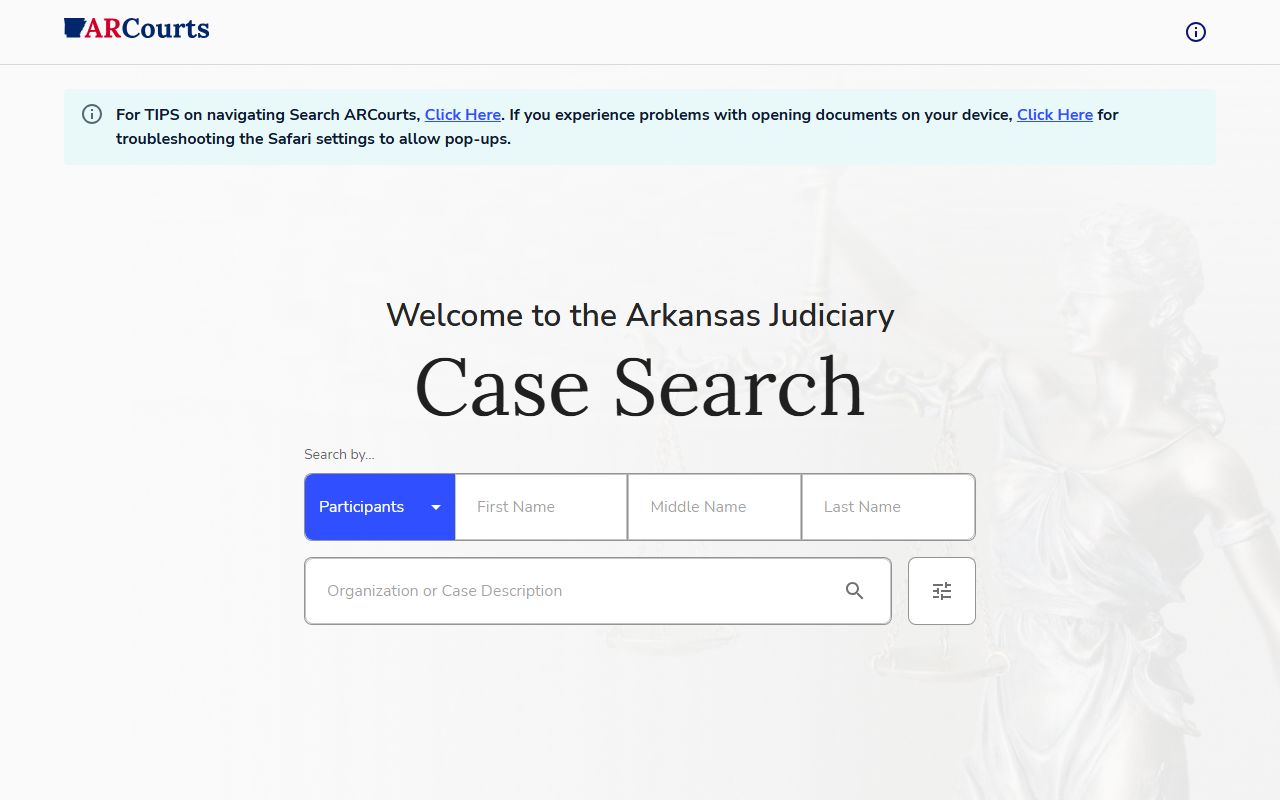
The state case system is the practical bridge between a Little River County arrest and the clerk's official court file.
Little River County Court Fields
Arkansas Case Search does not work like a jail roster. A roster lookup tries to answer whether a person is in custody now. Case Search is focused on court records, parties, case descriptions, court events, and filed charges. A person arrested in Little River County may not appear right away if the arrest is too recent, if the case has not been filed, if the wrong court level is searched, or if public access is restricted.
| Field | Type | Required | Use |
|---|---|---|---|
| Search by / search context | Dropdown | Optional | Participant search is the visible default; search fields can change by context. |
| First Name | Text | Optional | Use the defendant's legal first name when searching participant records. |
| Middle Name | Text | Optional | Helpful when a common name returns too many court records. |
| Last Name | Text | Optional | The most useful field for a defendant-name search. |
| Organization or Case Description | Text | Optional | Used when the search context supports organization or case-description queries. |
| Advanced filters | Button | Optional | Use to narrow by court, county, date, case type, or status when available. |
| Search | Submit button | Submit | Runs the public court-record search. |
Case results should be read with care. A case may show a charge entry, but the status of that charge may be pending, amended, dismissed, or resolved by plea or verdict. The clerk can confirm whether a printout is complete and whether a certified copy is available.
Little River County Clerk Records
Felony court records after a Little River County jail arrest generally route to Circuit Clerk because the local page states that the office handles felony criminal cases. District-level misdemeanors, traffic cases, and related bench-warrant or payment matters route to District Court. The offices are not the same address in the research. The Circuit Clerk is listed at the courthouse office address, while the District Court courtroom building is listed with the sheriff and jail complex on North Constitution Avenue.
| Office | Records handled | Contact | Fees or notes |
|---|---|---|---|
| Circuit Clerk | Felony criminal case files and official court copies | Lauren Abney, (870) 898-7212, labney@lrcounty.com | Copies $0.50 per page; certification $5.00 up to 10 pages and $0.50 per page after that; fax filing $1.00 per page. |
| District Court Clerk | Traffic violations, misdemeanor criminal offenses, small claims, and juvenile intake | Kristie Lewis, (870) 898-7230, klewis@lrcounty.com; mmills@lrcounty.com | District Court page lists online and in-person payments for filings and tickets; research also notes a $150 criminal-division district appeal fee. |
| Sheriff / jail | Current custody, booking, jail-log, release, bond, and hold questions | (870) 898-5115 | No official online roster was located, so call for current custody before relying on court records alone. |
The source page for felony records is the official Little River County Circuit Clerk page, which publishes criminal-case duties and copy fees.

Those local fee details are useful when a court record after an arrest must be turned into an official copy instead of a public search result.
Little River County Prosecutor Path
Little River County is served by the Prosecuting Attorney for Arkansas's Ninth Judicial District West, which covers Little River, Sevier, Howard, and Pike Counties. The county's own prosecuting-attorney page existed during research but was marked "Coming soon," so the more useful official source was the Arkansas Legislative Audit record for the office. That audit listed Jana Bradford as Prosecuting Attorney for the report period reviewed.
The prosecutor path explains why court records after a jail arrest can differ from booking notes. The sheriff page says sheriff staff may prepare and assemble evidence for the prosecuting attorney in felony and misdemeanor cases. Law enforcement may start with an arrest reason, warrant, citation, or incident report. The prosecutor then reviews the facts, chooses a formal charge when prosecution is supported, and may later amend or dismiss a count as the case develops.
Note: A booking charge is not proof that the prosecutor filed the same charge in court.
Little River County Charging Records
The filed charge record begins with a charging document or a court filing that states the accusation. Arkansas local pages do not publish a Little River County prosecutor filing manual, so the safest wording is functional: a complaint, information, indictment, citation, or related filing can create the case path depending on the offense and court. Felonies normally point toward Circuit Court, while misdemeanors and traffic matters may be handled in District Court.
| Document | Who usually starts it | Common Little River use | What to verify |
|---|---|---|---|
| Complaint | Officer, prosecutor, or court process | Often used to start a misdemeanor, traffic, warrant, or early criminal filing route. | Case number, defendant name, charge text, court, and next event. |
| Information | Prosecutor | Common formal charging instrument for felony prosecution after prosecutor review. | Count numbers, statute citations, felony level, amendments, and disposition. |
| Indictment | Grand jury | Possible for serious matters, though not every felony uses this path. | Filed counts, court seal issues, arraignment date, and whether the case is public. |
Little River County Charge Status
Charge status is the piece that keeps a court record from being a simple arrest list. A charge can be pending while the case is open, amended when the prosecutor changes the filed count, reduced as part of plea talks or legal review, dismissed by court order, or resolved by plea or trial. Nolle prosequi, often shortened to "nolle pros," means the prosecutor has declined to continue that charge at that stage, subject to the legal effect shown in the file.
| Status | What it means | What not to assume |
|---|---|---|
| Pending | The charge is open and still moving through court. | Do not call it a conviction. |
| Amended or reduced | The filed charge changed from an earlier version. | Do not rely on the booking charge as the final court charge. |
| Dismissed | The court record shows the charge did not proceed to conviction in that case. | Do not assume the public record is sealed. |
| Nolle prosequi | The prosecutor chose not to pursue that charge in the current posture. | Do not treat it as a guilty finding. |
| Convicted | A plea, verdict, or judgment resulted in conviction. | Check the sentence, probation, fines, and any later appeal or sealing order. |
Little River County Bond Records
Bond information may sit between the jail and the court. Little River County official pages do not publish a jail bond schedule, bond desk hours, accepted jail-bond payment methods, or a county-approved bondsman list. The District Court page does list online and in-person payment options for District Court filings and tickets at the sheriff's office, but those court-payment methods should not be treated as jail-bond rules unless the sheriff or court confirms them.
| Bond type | How it works | Little River County caution |
|---|---|---|
| Cash bond | The court requires cash payment of the amount set. | Call the jail or court before arriving with payment. |
| Surety bond | A licensed bail agent posts bond for a fee. | No official Little River bondsman list was located. |
| Personal recognizance | The court releases a person on a promise to appear. | This depends on a judge or court order, not a jail promise. |
| No-bond hold | Release is blocked until a court or holding authority changes status. | Ask whether the hold is local, DOC, federal, ICE, parole, probation, or another county. |
Little River County Warrant Records
No official Little River County active-warrant search page, warrant roster, most-wanted page, or sheriff app warrant lookup was located. The sheriff page does state that the sheriff executes court process and makes arrests on warrants issued by the courts. When a warrant leads to booking, the jail log may show warrant or commitment data, and the later court record may show a failure-to-appear event, revocation, new charge, or case update.
For felony warrants tied to Circuit Court, contact Circuit Clerk and the sheriff. For traffic, misdemeanor, bench-warrant, or failure-to-appear matters, contact District Court and the sheriff. Arkansas Case Search may help locate the case, but not every active warrant is safe to interpret from public search results. Some warrant or investigation material may be withheld if release would harm law enforcement work.
Little River County Charges
An arrest means a person was taken into custody. A charge means an accusation has been recorded by jail, police, prosecutor, or court process. A conviction means guilt was established by plea, verdict, or judgment. Little River County court records after an arrest should be read through those stages, because a public case record may contain accusations that never became convictions.
| Point of comparison | Charge | Conviction |
|---|---|---|
| Stage | Accusation filed or listed in the criminal process. | Result after plea, verdict, or judgment. |
| Proof level | May begin from probable cause or prosecutor review. | Requires the legal standard for conviction in court. |
| Record meaning | Shows what was alleged or pursued. | Shows an adjudicated criminal result. |
| Custody effect | May affect bond, holds, or first appearance. | May create jail sentence, probation, fines, or Arkansas DOC transfer. |
Little River County Sealed Records
Arkansas research for Little River County points to sealing rather than a simple web deletion process. The Circuit Clerk page notes no charge for petitions to seal qualifying criminal cases adjudicated after March 6, 2013, and the research cites Arkansas sealing provisions including Arkansas Code section 16-90-1405 and Arkansas Code section 16-90-1414. Eligibility depends on the offense, disposition, timing, and court order.
| Point of comparison | Sealed | Expunged |
|---|---|---|
| Public visibility | Restricted from ordinary public access after a valid order. | Often used casually to mean removal, but Arkansas research here points to the sealing process. |
| Record location | The record may still exist with limited official access. | Do not assume a file is destroyed unless a statute or order says so. |
| How to start | Ask the Circuit Clerk about the uniform petition and order to seal. | Use the clerk and Arkansas law, not a private website promise. |
| Limits | Juvenile, sealed, medical, security, and investigation material can remain restricted. | Eligibility is case-specific and may require legal advice. |
Little River County Record Limits
Arkansas Code section 25-19-105 generally gives Arkansas citizens inspection and copying rights for public records during regular business hours unless an exemption applies. For jail records, the sheriff is the best starting custodian because Arkansas law and the county page place the county jail and committed prisoners under the sheriff's custody. For court records, the clerk is the best starting custodian because official case files and certified copies come from the court office.
A public-record request should name the existing record wanted. For a court case, ask for the case file, docket sheet, charging document, disposition, sentencing order, or certified copy. For booking, ask for the jail-log entry, booking sheet, release record, bond record, or booking photo if releasable. A custodian is not required to create a new custom report just because a requester asks for a broad summary.
Little River County Background Checks
Casual court lookups and official consumer background checks are not the same thing. Arkansas Case Search can help locate public court records after a Little River County arrest, but case data can be incomplete, delayed, sealed, amended, or misunderstood without the clerk file. Consumer reports used for employment, tenant screening, credit, insurance, or similar decisions must follow separate federal and state rules.
Important: Public lookup notes are not consumer reports and cannot be used for FCRA-covered screening decisions.
Restricted Little River County Records
Some Little River County court records after an arrest may not be fully public. Juvenile records, sealed criminal cases, sensitive investigative material, medical or mental-health information, security records, and some active warrant details can be restricted. A dismissed charge also should not be treated as automatically erased from every public source. The correct next step is to ask the clerk whether the case is open, sealed, or subject to a specific court order.
No official Little River County sheriff or police mobile app with an inmate roster or warrant lookup was confirmed in the App Store, Google Play, or county site during research. That makes the public fallback chain more important: sheriff for custody, Arkansas Case Search for filed cases, the clerk for official records, Arkansas DOC for state-prison custody, VINELink for notifications, and BOP or ICE only when federal or immigration custody is involved.